
Why the Most Durable Family Structures Integrate Governance, Ownership, and Investments

America is entering the largest wealth transfer in its history. Trillions of dollars will move from one generation to the next over the coming two decades. Most families will focus on transferring the ownership of assets, however the greater challenge is transferring stewardship. Who will make decisions? How will assets be managed? How will family values endure?
Many families will devote significant attention to taxes, estate planning, and investment performance. All are important. Yet the greatest risk to generational wealth is often the failure to align governance, ownership, and investments. Families may have sophisticated trust and estate plans and capable investment advisors. But when these disciplines operate independently, responsibilities become unclear, succession planning fails, and family conflicts emerge. As families grow across generations, informal understandings become less effective. What worked when a founder made every decision no longer works when children, grandchildren, trustees, directors, and advisors all have a voice.
The solution for many families is an integrated framework that aligns governance, fiduciary structures, and investment strategy. Governance determines how decisions are made. Fiduciary structures establish ownership and continuity. Investment strategy guides the management of family capital. Together, these disciplines create a system capable of preserving and growing wealth across generations.
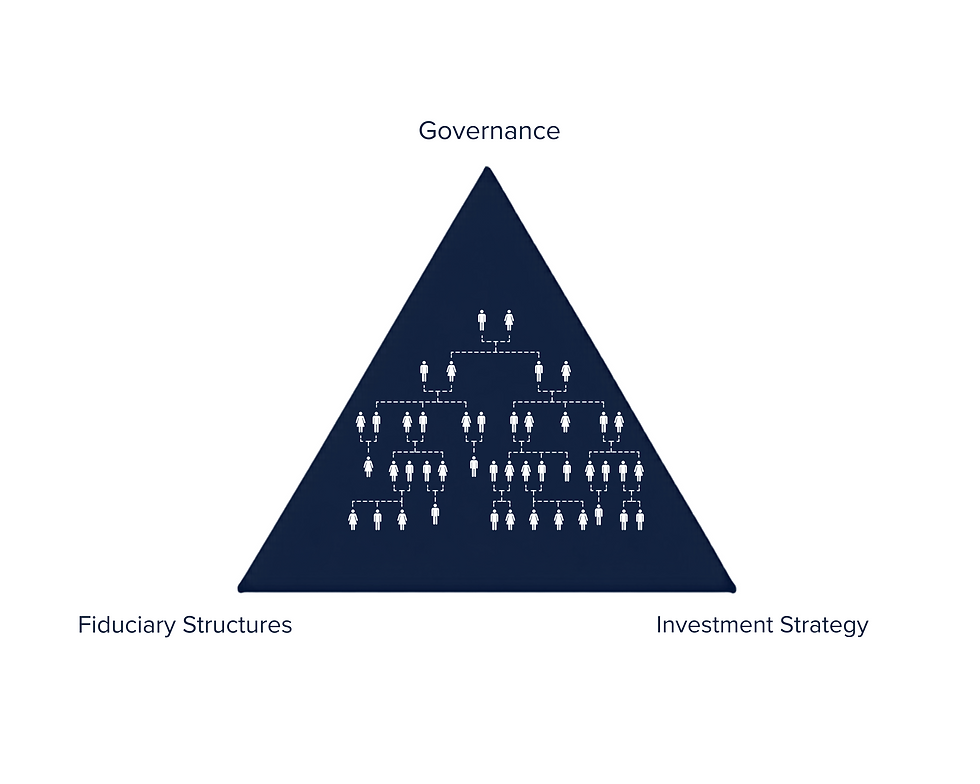
The relationship between the three is important. Governance establishes decision-making authority. Fiduciary structures define ownership and control. Investment strategy operates within that framework.
When governance, fiduciary structures, and investment strategy operate independently, families often encounter conflicting priorities, divergent advice, liquidity challenges, and missed opportunities. Cash may not be available when a capital call arrives. Assets may need to be sold at an unfavorable time to fund distributions or meet liquidity needs. Tax-sensitive structures may not be managed as intended. Family objectives may become disconnected from the way capital is invested. When these disciplines operate as a single integrated system, families tend to make better decisions and achieve better long-term outcomes.
This is why families with multigenerational wealth need more than an estate plan or an investment advisor. They need a framework that brings governance, fiduciary oversight, and investment strategy together.
For an increasing number of families, that framework is built around a private trust company. A well-designed PTC allows governance, fiduciary structures, and investment strategy to operate within a single system rather than in separate silos. Families remain actively involved in decision-making while creating processes that endure across generations.
Wyoming and Nevada have become leading jurisdictions for these structures because their trust laws provide the flexibility needed to support long-term family ownership, governance, fiduciary administration, and succession planning.
The most durable family structures integrate governance, ownership, and investments. Governance guides decision-making. Fiduciary structures establish ownership and continuity. Investment strategy preserves and grows family capital. Together, they create a framework of stewardship across generations.
ABOUT US
Two Ocean partners with ultra‑high net worth individuals, families, and foundations as a trusted fiduciary. Our capabilities include trust administration, private trust company governance, and integrated investment services.
As an independent, partner‑owned trust company, we work with a select number of clients, allowing us to manage fiduciary and investment structures tailored to each client’s specific needs. The result is durable long-term partnerships built on trust and alignment. With offices in Jackson Hole and Las Vegas, Two Ocean provides access to the tax advantages, modern trust laws, and privacy protections of both Wyoming and Nevada.

